
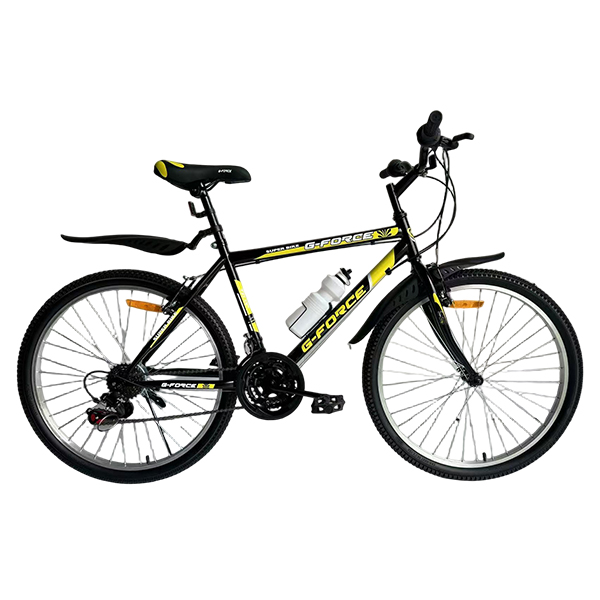
Container Planning for Export Mountain Bike Ranges
Export distributors rarely order one mountain bike model at a time. A container is normally a mixture: several frame sizes per model, two or three models, and sometimes a small quantity of parts to fill remaining space.
That mixture changes the packing math. Frame size affects carton dimensions, and a 29 inch model will not stack the same way as a 26 inch one. Planning sizes per carton early avoids a container that arrives half loaded or one that has to be topped up with unrelated stock.
Share the model mix, size breakdown and target container type, and we will return a loading plan together with the quantity that actually fits, rather than a round number that leaves space unused.
Where this sits on the site
If you are putting a container together, the pages below carry the model range, the trade terms and the quote form.
Trade programme requirements come before product choice
A trade chain buys bicycles the way it buys any other article: on delivery windows, carton specification and order multiples. Three requirements decide whether a good mountain bike can actually be supplied to that channel:
- Delivery window — the chain fixes when stock must arrive, which works backwards into production and shipping dates.
- Carton and label compliance — barcode format, label position, carton mark and pallet configuration, all specified by the chain.
- Order multiples — the chain orders in fixed multiples per store, which usually means the quantity per model has to divide evenly across stores.
A model that fits the price and the market but fails these three never reaches the shelf, so they belong at the start of the enquiry.
Supplying a chain versus supplying a distributor
| Point | Trade chain | Distributor |
|---|---|---|
| Order shape | Fixed multiples per store, single delivery window | Broader range, quantities set by the distributor |
| Carton | Defined by the chain’s specification | Agreed between buyer and factory |
| Assembly | Usually assembled or trade-ready | Often semi-assembled |
| Support | Chain handles service centrally | Distributor supplies shops with parts |
Documents and timing
Which documents the destination requires, and who produces them, should be settled at quotation. Where a buyer is new to the market, confirm the document list for that destination rather than assuming a standard set, because the requirement is set by the importing country, not by the factory.
Mixed pallets and pallet configuration
Trade deliveries are often palletised to a height limit the chain specifies. That limit, not the container volume, decides the pallet build, and it may reduce the number of bicycles per pallet compared with a container-only plan. Ask for the pallet specification before the loading plan is written.
What to send
Channel type, delivery window, carton and label specification, order multiples and pallet limits. Related pages: wholesale MTB models for outdoor bike shops, MTB models for distributor entry programmes and the container loading and shipping terms guide.
Working backwards from the delivery window
A trade delivery window is a fixed date, and everything else in the order is calculated from it: inland transport at the destination, shipping time, production, sample approval, and artwork approval before production. Written as a schedule, the window usually reveals that the binding constraint is not production but an approval nobody has booked time for.
Where the arithmetic does not fit, the honest options are a smaller first delivery inside the window and a second delivery later, or a later window. Compressing production to hit a date that was never feasible is how a chain receives bicycles after its seasonal reset, which is worse than receiving fewer on time.
Trade programmes also fix the order multiple per store, so the quantity per model has to divide evenly across the stores being served. A model ordered in a quantity that does not divide leaves one store short and another holding stock it cannot display, and the chain notices that before it notices the bicycle.
Record the delivery window, the order multiple and the pallet limit on one page with the buyer, and date it. That page is what both sides refer to when a shipment slips, and it prevents the window from being renegotiated from memory later in the season.